Chassis canon
Honda Civic Type R EK9 (1997–2000): Chassis Reference, B16B Specs & Import Eligibility
EK9
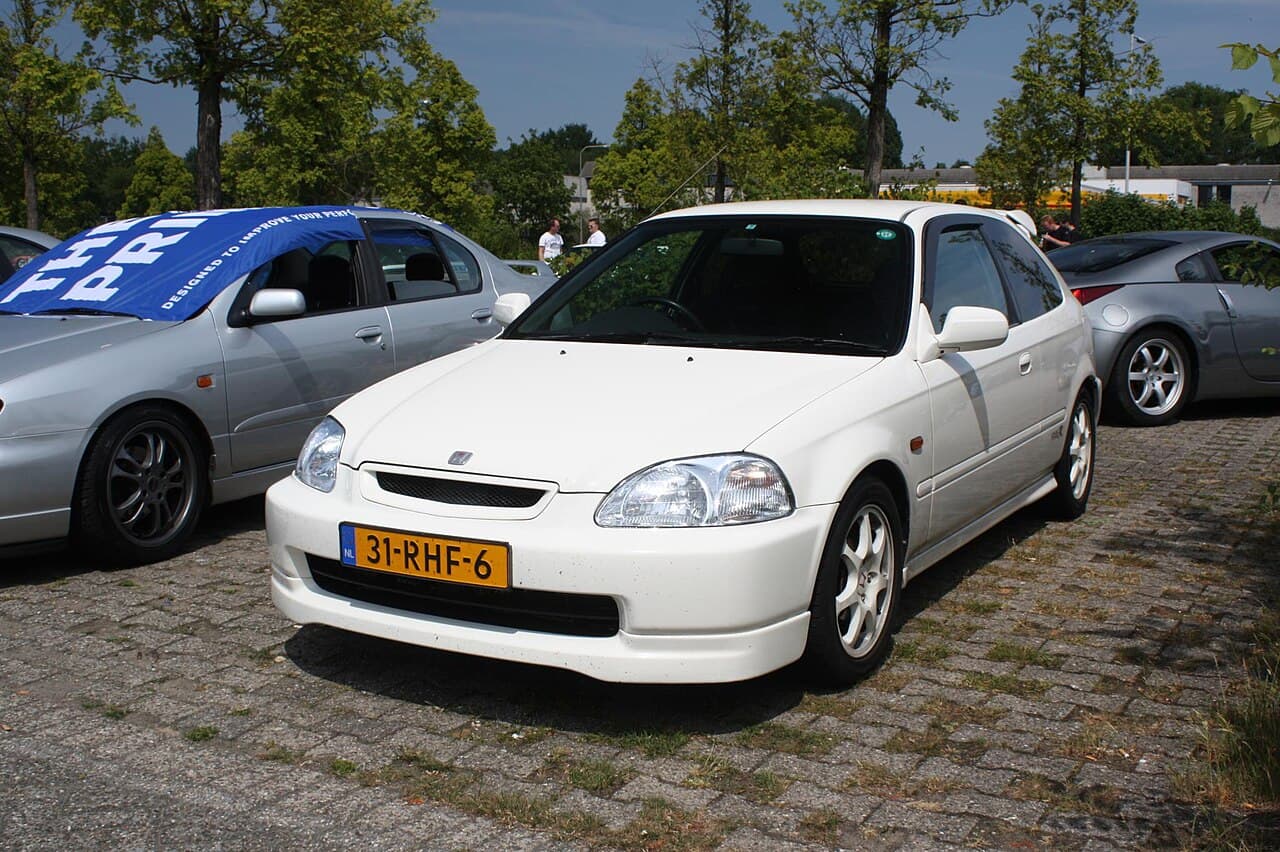
Why the EK9 is sought
The EK9 was the first Civic to wear the Type R badge, launched in Japan in August 1997 and built only there. It paired an unusually stiff, seam-welded three-door body with a hand-assembled engine, a helical limited-slip differential and a stripped, driver-focused cabin (Recaro seats, Momo wheel, red carpet). It is prized as the purest of the naturally aspirated front-drive Type Rs — light, high-revving and Japan-only — which is why clean examples now command a premium among JDM collectors.
The B16B engine
The heart of the EK9 is the B16B, a 1.6-liter (1,595 cc) DOHC VTEC inline-four with a cylinder head hand-ported at Honda's Suzuka plant. It produces 185 PS (about 182 hp) at 8,200 rpm and 160 Nm (16.3 kgf·m) at 7,500 rpm, on a 10.8:1 compression ratio, spinning to roughly an 8,400 rpm limit. Its 115.6 PS per liter was the highest specific output of any 1.6-liter naturally aspirated production engine at the time of launch. Power runs through a close-ratio five-speed manual to the front wheels via a helical LSD.
| Item | Figure |
|---|---|
| Engine | B16B, 1.6L DOHC VTEC I4 |
| Power | 185 PS @ 8,200 rpm |
| Torque | 160 Nm @ 7,500 rpm |
| Compression | 10.8:1 |
| Transmission | Close-ratio 5-speed manual + helical LSD |
| Curb weight | ~1,040–1,050 kg |
Chassis and trim timeline
Production ran August 1997 to August 2000. A 1998 update (for the 1999 model year) brought one-piece headlights, a revised front bumper with brake-cooling ducts and a wider intake grille. In 1999 Honda added the more road-oriented Type Rx trim, which fitted amenities the base car omitted — automatic air conditioning, a CD stereo, remote central locking and drilled aluminum pedals — while keeping the same B16B drivetrain. Dimensions stayed compact throughout: 4,185 mm long, 1,695 mm wide, 1,360 mm tall on a 2,620 mm wheelbase.
US and Canada import eligibility
The EK9 was never federalized for North America, so importing one relies on age-based exemptions — and the trigger is the month and year of manufacture on the compliance plate, not the model year.
- United States (25-year rule): Vehicles at least 25 years old are exempt from Federal Motor Vehicle Safety Standards (FMVSS) conformance under 49 CFR Part 591. Because the last EK9 left the line in August 2000, every EK9 has now crossed the 25-year threshold as of 2026. FMVSS is waived, but EPA emissions handling and state registration still apply.
- Canada (15-year rule): Transport Canada exempts vehicles manufactured more than 15 years ago from Motor Vehicle Safety Act compliance at import, placing all EK9s well past the line; CBSA entry and provincial registration still apply.
Eligibility is per-chassis: confirm the individual car's build month against the door-jamb plate before committing. Use the site's import-check tool to translate a specific VIN and build date into a clear eligible/not-eligible answer.
Specs at a glance
The EK9 is chassis canon: a 6th-generation Civic hatch (EK platform) turned into a homologation-grade road car. Sourced figures are listed in the specifications table on this page; where a source range exists (curb weight), the variation reflects trim and measurement standard rather than a single "correct" number.
Sources
FAQ
- What engine does the EK9 Civic Type R use?
- The B16B - a 1.6-liter (1,595 cc) DOHC VTEC inline-four with a cylinder head hand-ported at Honda's Suzuka plant. It is rated 185 PS (about 182 hp) at 8,200 rpm and 160 Nm at 7,500 rpm, on a 10.8:1 compression ratio, revving to roughly 8,400 rpm. Its 115.6 PS per liter was the highest specific output of any 1.6L naturally aspirated production engine at launch.
- Can the EK9 be imported into the United States under the 25-year rule?
- EK9s were built between August 1997 and August 2000, so every chassis has now crossed the US 25-year threshold, which exempts it from FMVSS conformance under 49 CFR Part 591. Eligibility is calculated from the month and year of manufacture on the compliance plate, not the model year, and EPA emissions handling plus state registration still apply - so verify the specific car's build month before importing.
- How is the EK9 Type R different from a standard EK4 Civic SiR?
- Both share the sixth-generation EK hatch, but the Type R adds the hand-ported B16B (versus the B16A), a seam-welded and reinforced body, a close-ratio five-speed with a helical LSD, Recaro seats and a Momo wheel, and reduced weight of roughly 1,040-1,050 kg - making it a homologation-grade version rather than a warm hatch.
This article is for information only and is not legal, import, or purchasing advice. Eligibility rules are described structurally — the vehicle's actual manufacture month, verified per chassis, is the final basis, and federal import and state/provincial registration are separate hurdles. Prices and availability change; confirm on the official source linked in the article before acting.
